Hand-tuned gains don't survive a chassis change
The navy curve is the target line the robot has to follow (deliberately curvy, like a track with bends). The copper path is the robot's actual trajectory when the motor has been swapped but the PID gains have not. Watch it drift out of the tolerance band on the turns.
What this is
A robot follows a curvy line with a PID controller. When a student swaps
motors or tires, the PID gains that worked yesterday no longer fit.
Rather than re-tune by hand, a contextual bandit picks kp, kd
from a discrete menu based on a short feature vector describing the
chassis. The animation below uses traces pre-computed by
scripts/run_experiments.py.
Robot
Timeline: line error
Offline summary charts
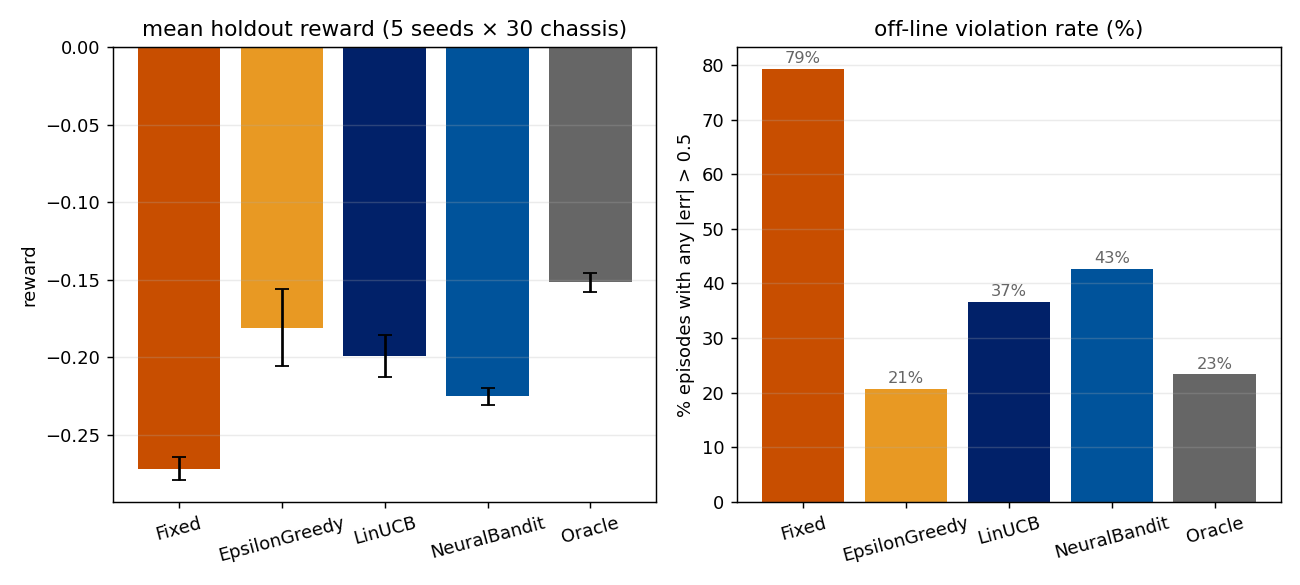
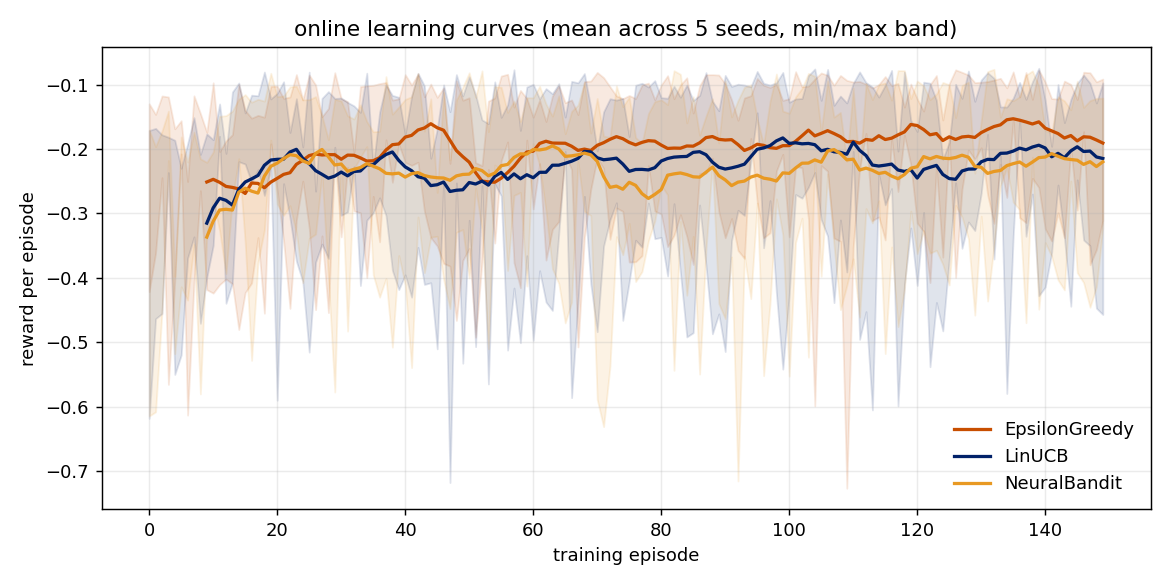
Holdout summary (5 seeds × 30 chassis)
| policy | mean reward | violation rate | notes |
|---|
Alignment: a reward-hacking demo
Give the bandit a knob for forward speed and set reward to
-MAE only. It learns to pick the slowest arm. The robot
idles near the starting line with near-zero error and never tracks the
curve. Penalizing travel deficit fixes it.
Full training plots
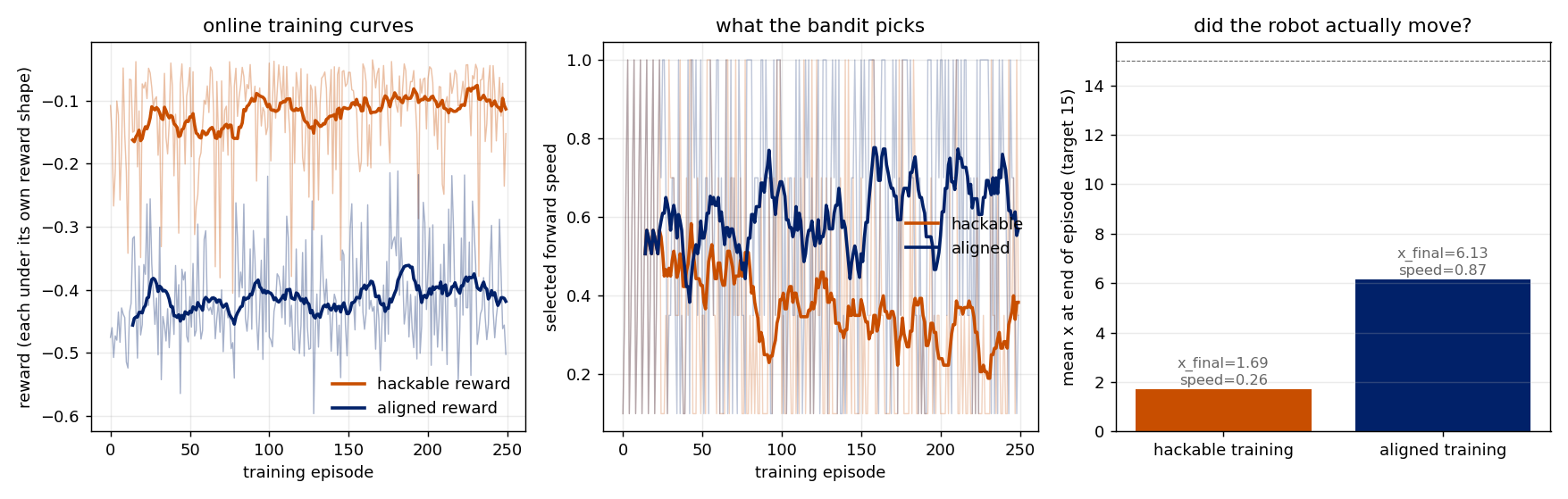
| hackable reward | aligned reward |
|---|